
Moissanite vs. Diamond: What's the Difference?
If you've been shopping for jewelry lately, you've probably come across moissanite. It sparkles, it's durable, and it costs a fraction of what a diamond does. So what exactly is it, and how does it compare? Here's a quick, clear look at both.
The short answer
Moissanite is a lab-grown gemstone made of silicon carbide, while a diamond is made of pure carbon. Moissanite has more colourful sparkle, ranks 9.25 on the Mohs hardness scale (diamond is 10), and typically costs about one-tenth the price of a similar-sized diamond. Across a room, most people can't tell them apart.
What is moissanite?
Moissanite is a gemstone made of silicon carbide. It isn't a diamond, a fake diamond, or cubic zirconia. It's its own mineral with its own properties.
It also has a fun backstory. In 1893, French chemist Henri Moissan found tiny sparkling crystals near a meteor crater in Arizona. He thought they were diamonds at first, but they turned out to be something new, and the stone was later named after him. So yes, moissanite was first discovered thanks to a meteorite.
Natural moissanite is extremely rare, so all the moissanite used in jewelry today is grown in a lab. That means each stone is consistent in quality and clarity, and no mining is involved.
Moissanite vs. diamond comparison chart
Here's how the two stones compare at a glance.
| Feature | Moissanite | Diamond |
|---|---|---|
| Made of | Silicon carbide | Carbon |
| Origin | Lab-grown | Mined or lab-grown |
| Sparkle | More colourful, rainbow-like flashes | Bright, white sparkle |
| Fire (dispersion) | 0.104, about 2.4 times a diamond | 0.044 |
| Refractive index | 2.65 | 2.42 |
| Hardness (Mohs scale) | 9.25 | 10 |
| Resistance to chipping | Very good | Good, but can chip if struck at certain angles |
| Double refraction | Yes, visible under magnification | No |
| Gets cloudy over time? | No | No |
| Price | About one-tenth of a comparable diamond | Higher |
Which sparkles more, moissanite or diamond?
Moissanite has more sparkle, especially the colourful kind. It has a higher refractive index than a diamond (2.65 vs. 2.42), and it spreads light into about 2.4 times more colour.
Sparkle is really three things working together:
- Brilliance is the bright white light a stone reflects back to you.
- Scintillation is the little flashes you see when the stone moves.
- Fire is the rainbow colour a stone throws off as it splits light.
Diamonds are known for bright, white brilliance. Moissanite has more fire, so you'll see little rainbow flashes, especially in sunlight. Some people love that extra colour, and others prefer the softer look of a diamond. It really comes down to personal taste, so it's worth seeing both if you can.
Is moissanite as durable as a diamond?
Almost. Diamonds are the hardest natural mineral, scoring a 10 on the Mohs scale. Moissanite is close behind at 9.25, which is harder than sapphires and rubies. That makes it a great choice for engagement rings and other everyday jewelry.
Moissanite also resists chipping well, because it doesn't have the same natural splitting points that diamonds do. Neither stone turns cloudy or yellow with age.
Care tip: A gentle clean with warm water, a drop of dish soap, and a soft toothbrush will keep either stone shining.
Can people tell the difference between moissanite and a diamond?
At a glance, most people can't. The two look very similar in everyday settings.
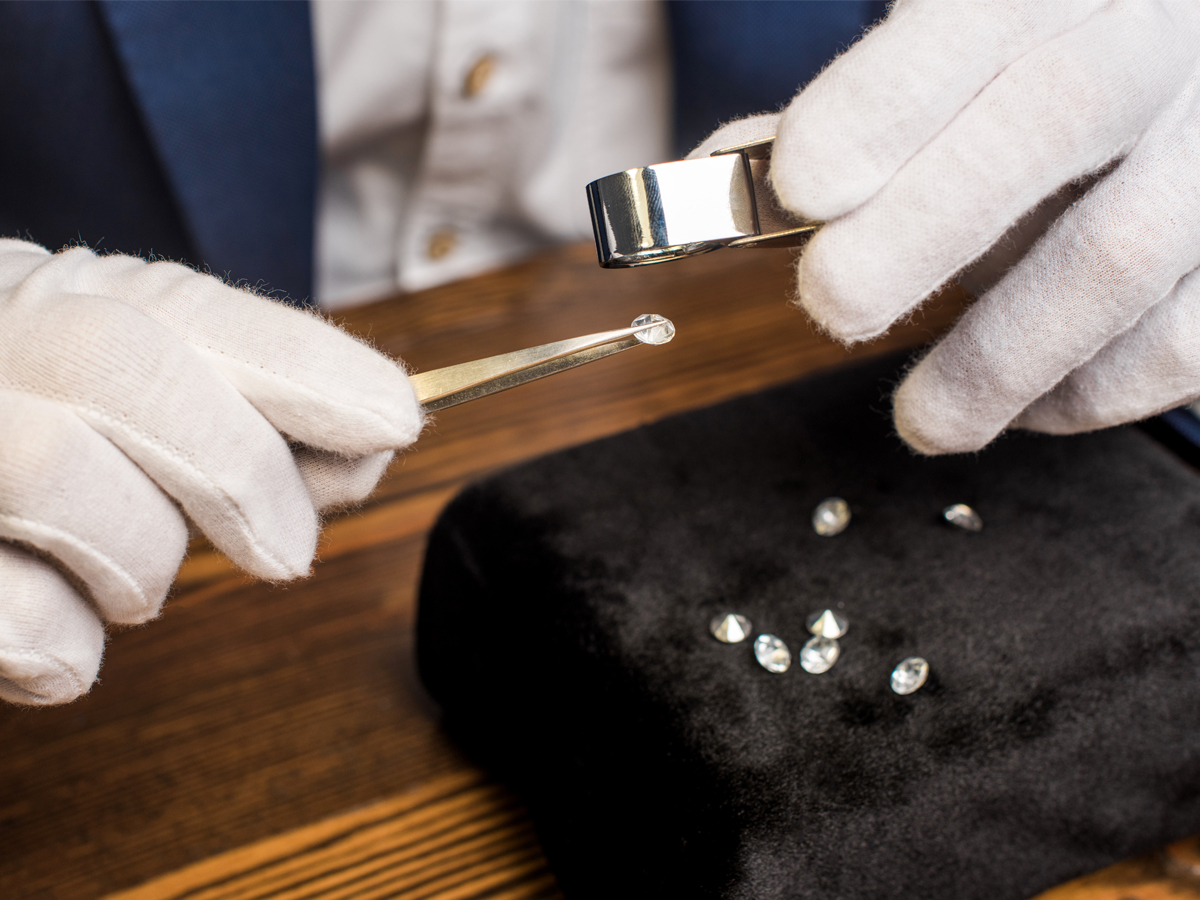
A jeweller using a magnifying loupe can spot moissanite by looking for double refraction, which makes the facet edges look slightly doubled. A diamond doesn't do this.
Many basic diamond testers measure heat conductivity, and moissanite can read as a diamond on them. A tester that measures electrical conductivity, or a professional appraisal, can tell the two apart.
How much does moissanite cost compared to a diamond?
This is where moissanite really stands out. It typically costs around one-tenth the price of a diamond of similar size and quality. That makes it easy to choose a larger stone, add a matching piece, or simply stay within budget.
The price gap is even more noticeable in pieces with lots of stones, like a moissanite tennis bracelet, where a full row of diamonds would cost much more.
Moissanite vs. lab-grown diamond
Lab-grown diamonds and moissanite are both made in a lab, but they aren't the same thing.
A lab-grown diamond is a real diamond. It's made of carbon, just like a mined diamond, and it has the same hardness and white sparkle. Lab-grown diamonds usually cost less than mined diamonds, but more than moissanite.
Moissanite is a different gemstone. It has more colourful sparkle and is usually the most budget-friendly of the three.
If you want a true diamond without the mined-diamond price, a lab-grown diamond may suit you. If you want the most sparkle for your budget, moissanite is hard to beat.
Which one is right for you?
Choose a diamond if
You love tradition or prefer a classic white sparkle.
Choose moissanite if
You want a durable, eye-catching stone with extra colour and a friendlier price.
Moissanite is also a lovely option for pieces that would be hard to find in diamond at an everyday price, like a full tennis bracelet or a 2-carat moissanite ring.
Where to buy moissanite in Canada
Ready to take a look? WagJag has moissanite deals on rings, bracelets, and more, delivered across Canada. Here are a few of our favourites.
2-Carat Moissanite Ring
Plenty of shine for everyday wear or a special occasion.
View the moissanite ring9-Carat Tennis Bracelet
A timeless way to add a little sparkle to your wrist.
View the tennis braceletFrequently asked questions
Is moissanite a real diamond?
No. Moissanite is a real gemstone, but it isn't a diamond. It's made of silicon carbide, while diamonds are made of carbon. It's also not cubic zirconia or a diamond imitation. It's its own mineral.
Is moissanite a lab-grown diamond?
No. Both are made in a lab, but a lab-grown diamond is made of carbon and is chemically a real diamond. Moissanite is a different gemstone made of silicon carbide, with more colourful sparkle and a lower price.
Does moissanite pass a diamond tester?
It can. Basic diamond testers that measure heat conductivity often read moissanite as a diamond. Testers that measure electrical conductivity, or a jeweller's appraisal, can tell them apart.
Does moissanite get cloudy?
No. Moissanite won't turn cloudy or change colour over time. Like any gemstone, it can look dull when lotion or everyday grime builds up, and a quick clean with warm, soapy water brings the sparkle right back.
How is moissanite made?
Moissanite is grown in a lab from silicon and carbon under very high heat. The crystals are then cut and polished into gemstones. Natural moissanite is too rare to use in jewelry, so all moissanite sold today is lab-grown.
Is moissanite good for an engagement ring?
Yes. At 9.25 on the Mohs scale, moissanite is hard enough for everyday wear and resists chipping well. Many people choose it for engagement rings because it looks similar to a diamond at a much lower price.
Does moissanite hold its value?
Moissanite has little resale value, so it's best to buy it because you love it rather than as an investment. Most diamonds also resell for well below their original retail price.
Whether you choose moissanite or diamond, the best piece is the one you'll love wearing.
Prices and availability are subject to change. See each deal for details.